

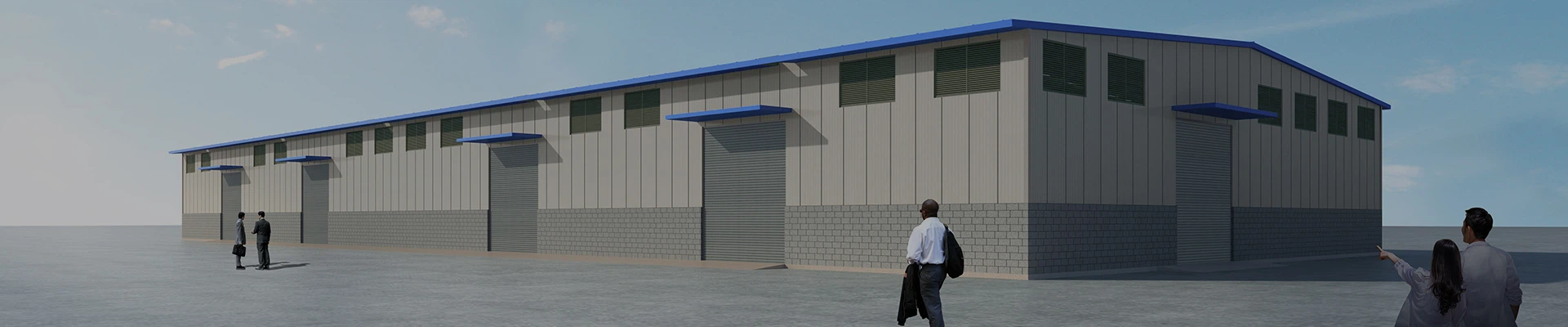


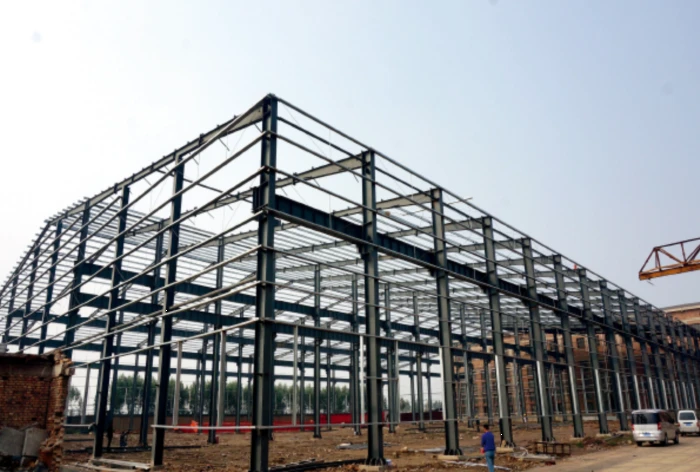
The portal rigid frame structure is a lightweight spatial load-bearing structure composed of steel beams, steel columns, joint connectors and bracing systems. It is widely used in large-span buildings such as industrial plants, warehouses and exhibition centers. The design of its components directly determines the load-bearing capacity, stability and construction convenience of the structure. The functions and structural characteristics of the core components are elaborated in detail below.
Steel beams and steel columns are the primary load-bearing components of portal rigid frames, usually made of welded H-shaped steel or hot-rolled H-shaped steel. The cross-sectional form shall be optimized in accordance with span, load and seismic requirements.Most steel beams adopt a variable-section design: the section height is increased at the supports to resist larger bending moments, while the section is reduced at positions with smaller loads to save steel materials. Steel columns often adopt a variable-section or constant-section design. Their column bases are connected to the foundation via hinged joints, bearing axial compression and horizontal shear forces.

Joint connectors are the key to ensuring the structural integrity, including beam-column joints, column-foundation joints and beam-beam splicing joints.Most beam-column joints adopt rigid connections, which are realized by matching high-strength bolts with end plates; the thickness of the end plates must meet the bending resistance requirements. Column-foundation joints are connected by embedded anchor bolts, and the quantity and arrangement of the anchor bolts shall be determined through uplift resistance verification.

The bracing system is divided into longitudinal bracings and transverse bracings, whose core function is to resist horizontal loads (wind loads and seismic loads) and prevent component instability.
Longitudinal bracings are arranged between columns along the length direction, while transverse bracings are installed at the ends or intermediate bays of the rigid frame. Cross bracings and diagonal bracings are the commonly adopted forms, and the materials are mostly channel steel or angle steel.
In addition, as secondary components, roof purlins and wall girts not only bear the loads of the enclosure structure, but also provide lateral constraints for the rigid frame, enhancing the overall stiffness of the structure.

In conclusion, all components of the portal rigid frame work collaboratively to bear loads and perform their respective functions. Component design must balance mechanical rationality and structural simplicity. By adopting standardized components and optimizing joint configurations, we can effectively reduce construction costs and shorten the construction period, highlighting its application advantages in large-span lightweight steel structures.
Hot Tags: core components and characteristics of portal frame structures, China core components and characteristics of portal frame structures manufacturers, suppliers, factory, Braced Frame Structure


