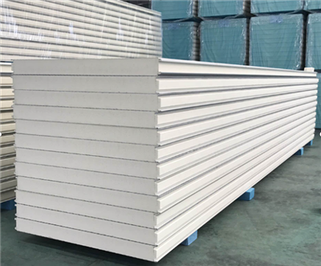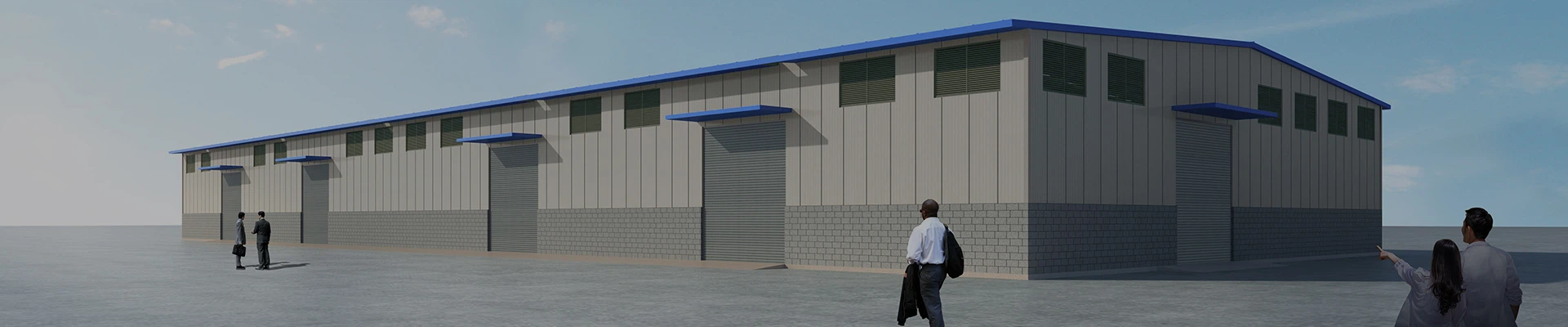


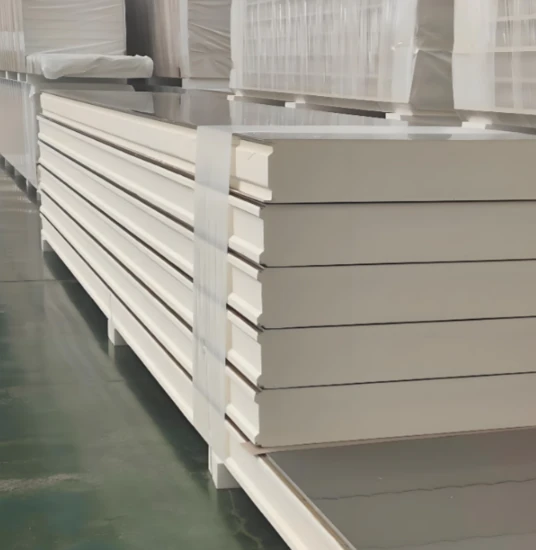
The cold room wall sandwich panels are sandwich-type insulated composite panels used to construct the walls, ceiling, and floor of the cold storage facility. Their primary functions are thermal insulation, moisture-proof sealing, and structural load-bearing, and they directly determine the cold storage facility's energy consumption and service life.
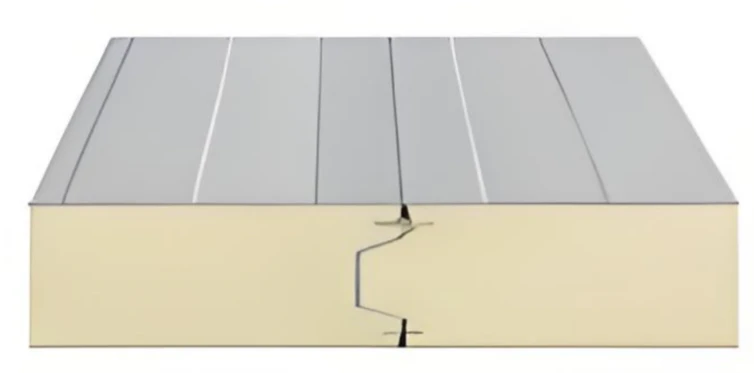
Basic Structure of the Cold Room Wall Sandwich Panels
The cold room wall sandwich panels feature a three-layer composite sandwich structure consisting of inner and outer metal panels, an insulating core layer in the middle, and interlocking joints and sealing mechanisms.
1. Top and Bottom/inner and Outer Layers (Metal Panels)
Common materials for cold room wall sandwich panels include: color-coated steel sheets, stainless steel sheets, galvanized steel sheets, and aluminum sheets.
Functions:
- Protects the internal core material
- Waterproof, moisture-resistant, corrosion-resistant, and easy to clean
- Enhances the overall strength of the panel and prevents warping
2. Core Layer (Insulation Core)
Common materials for cold room wall sandwich panels: polyurethane (PU), rock wool
Function:
- Provides thermal insulation and blocks the transfer of heat and cold
- Reduces energy consumption in cold storage facilities and prevents condensation and ice buildup
- Supports panels and enhances panel rigidity
3. Side-seam Construction
Male and Female Interlocking Grooves: Interlocking joints between panels
Eccentric Hooks/Built-in Locking Hooks: Tighten and secure for a tight, seamless joint
Sealant Groove: Apply sealant during installation to prevent air leaks and thermal bridges
4. Characteristics of One-Piece Molding
The cold room wall sandwich panels are molded as a single unit using high-pressure foaming at the factory; the panels are bonded to the core layer with high strength, ensuring no delamination or adhesive failure.

Standard Practice for Installing Overlapping Cold Room Wall Sandwich Panels
1. General Principles for Overlapping cold room wall sandwich panels
Vertical panels are installed upright; horizontal panels are staggered; tongue-and-groove joints interlock; hook-and-lock fasteners secure the panels; sealant is applied to all joints; and upper and lower joints are staggered to prevent alignment, thereby eliminating thermal bridges, drafts, and condensation.
2. Panel Jointing Methods for the Cold Room Wall Sandwich Panels
Vertical Wall Panel Overlap:
- Install the bottom panel upright first, then insert the top panel into the tongue-and-groove joints from top to bottom.
- Align the edges of the top and bottom panels and join them using an embedded overlap joint; secure them in pairs using the built-in eccentric hooks.
- Apply polyurethane sealant to the top-to-bottom joint, ensuring full coverage without any gaps.
- Install the wall panels vertically, with staggered joints, to avoid vertical through-seams.
Roof Deck Overlap:
- Install the ceiling panels horizontally, aligned with the span of the cold storage facility.
- Interlock the panels using tongue-and-groove joints and secure them with internal hook locks.
- At the junction between ceiling and wall panels, overlap the panels using inside corner trim pieces, and seal and compact the corners.
- Position ceiling panel overlaps to avoid door openings, and use full-length panels as much as possible to minimize joints.
3. Corner Lap Joints (Wall Corners, Column Corners)
Use specialized aluminum alloy or color-coated steel corner guards with overlapping inner and outer layers:
Cut the wall panels at a 45° angle for diagonal joints, or press straight seams together using corner fittings.
Apply sealant to all corner joints to form a continuous, sealed loop.
Key Processes for Overlapping the Cold Room Wall Sandwich Panels
1. Offset Joint Requirements
Cross joints between horizontal and vertical panels must be offset; continuous straight joints are not permitted to minimize thermal bridges and air leakage.
2.Male and female groove lap joint
Fully insert the joint end to end without looseness or warped edges, and ensure uniform gaps.
3. Eccentric Hook Locking
Each panel must have at least two hook locks at the top, bottom, and center; after tightening, the panel surface must be flat with no unevenness.
4. Sealing
Apply neutral Polyurethane sealant continuously to all lap joints, butt joints, and corner joints, ensuring the sealant is fully filled with no voids.
5. Leveling Height Differences
After joining, the panel surface must be flush, with a height difference of ≤2 mm, and must not trap dirt or cause condensation.
Common Mistakes of Cold Room Wall Sandwich Panels
- Panels are joined tightly without gaps and without adhesive
- Panels are joined end-to-end with straight seams, and cross seams are centered
- Tongue-and-groove joints are not fully inserted, and hooks are not locked
- Corners are not covered, leaving gaps exposed
- Ceiling panels are placed directly against wall panels without a sealed finish

Usage Scenarios and Scope of the Cold Room Wall Sandwich Panel
1. Refrigerator Door Panels for the Food Industry (Most Common)
Fresh-keeping storage (0–5°C): fruits, vegetables, fresh flowers, fresh milk, and tea; typically uses 50–75 mm PU panels.
Freezer (–18––25°C): Pork, beef, and lamb; seafood; frozen foods; and prepared meals; typically uses 100–150 mm PU panels.
Quick-Freezing Chamber (–35––60°C): Seafood; rapid freezing of meat; and quick-freezing tunnels; typically uses 150–200 mm PU panels.
2. Pharmaceuticals and Biotechnology
Pharmaceutical Cold Storage (2–8°C): Cool storage for vaccines, biologics, reagents, and pharmaceuticals; typically uses 75–100 mm PU panels with a stainless steel surface that is antimicrobial and easy to clean.
Low-Temperature/Ultra-Low-Temperature Storage (-20–-80°C): Blood, stem cells, and biological samples; 200 mm PU + VIP composite, with a temperature control accuracy of ±0.5°C.
3. Cold Chain Logistics
Cold-chain Warehouses/Distribution Centers: Fresh food e-commerce, regional distribution centers, temperature-controlled warehousing.
Refrigerated Trailers/Mobile Cold Storage Units: Fresh food transportation, temporary transshipment; lightweight 50–75 mm PU panels, waterproof and shock-resistant.
Low-Temperature Sorting/Processing Rooms: Fresh produce sorting, prepared meal processing; 75–100 mm PU panels, balancing thermal insulation with operational space.

summary
In summary, the cold room wall sandwich panels offer excellent thermal insulation, fire resistance, and moisture resistance, along with a sturdy structure and easy installation. They are widely used in food refrigeration and freezing, quick-freezing processing, pharmaceutical cold chains, logistics and warehousing, cleanrooms, temperature-controlled facilities, and specialized low-temperature storage applications. With thicknesses and materials that can be selected to meet specific temperature requirements, these panels are energy-efficient, durable, and highly versatile, making them an indispensable core material for all types of cold storage facilities and temperature-controlled insulation projects.
Hot Tags: cold room wall sandwich panels, China cold room wall sandwich panels manufacturers, suppliers, factory, exterior panel wall, Glass Wool Sandwich Wall Panels, Partition Wall And Ceiling Sandwich Panel