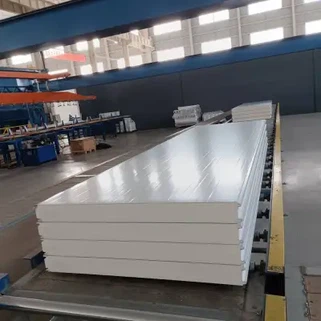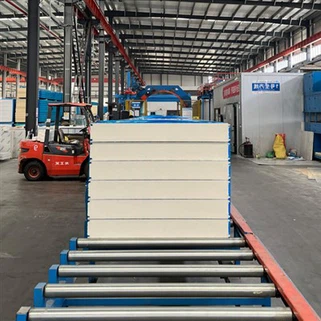


Glass wool sandwich panels are a type of metal-faced sandwich panels. They are a "sandwich" structured board, composed of two layers of high-strength metal panels (usually color steel plates) and a glass wool core in the middle. They are bonded together through special adhesives and a high-temperature, high-pressure curing process.
1.Surface layer:
Common materials include galvanized steel sheets, galvalume steel sheets, stainless steel sheets, etc. The surface can be coated with PE, PVDF, HDP or other coatings, providing corrosion resistance, weather resistance and an attractive appearance.
2.Core material:
Glass wool. It is an artificial inorganic fiber made from glass as the main raw material, through high-temperature melting and centrifugal blowing. Then it is formed into felt-like or board-like shapes with certain strength via special processes.
3.Laminating process:
Usually, polyurethane (PUR) or foam adhesive is used as the structural adhesive. It is laminated in one go on a continuous production line, ensuring firm bonding.

Main Features and Performance
1. Excellent thermal insulation performance:
The glass wool core has an extremely low thermal conductivity (usually 0.030-0.044 W/(m·K)), making it an excellent thermal insulation material. The sandwich panel structure effectively blocks cold and heat bridges, and its thermal insulation performance is far better than that of single-layer steel plates.
2. Excellent fire resistance performance:
Glass wool is a Class A1 non-combustible material with a melting point above 1000℃. Sandwich panels made from it usually meet Class A (non-combustible) or Class B1 (flame-retardant) fire safety standards. They are the top choice for factories, warehouses and other places with high fire protection requirements.
3. Good sound insulation and absorption performance:
Glass wool's multi-fiber structure effectively absorbs and blocks airborne sound. It is often used in workshops, engine rooms and other places that require noise control.
4. Light weight and high strength:
The "sandwich" structure gives it high specific strength (strength-to-weight ratio). It can not only serve as an enclosure structure but also bear a certain load.
5. Convenient installation and short construction period:
The panels are prefabricated in the factory with standardized sizes.On-site, only assembly is needed (such as bolt connection and interlocking).It's a dry construction method, and the installation speed is extremely fast.
6. Durability and Aesthetics:
The metal panels are corrosion-resistant and anti-aging. They come in a variety of coating colors and can keep the building's appearance clean for a long time. They have a long service life.
Main Uses
Thanks to its comprehensive performance, glass wool sandwich panels are widely used in:
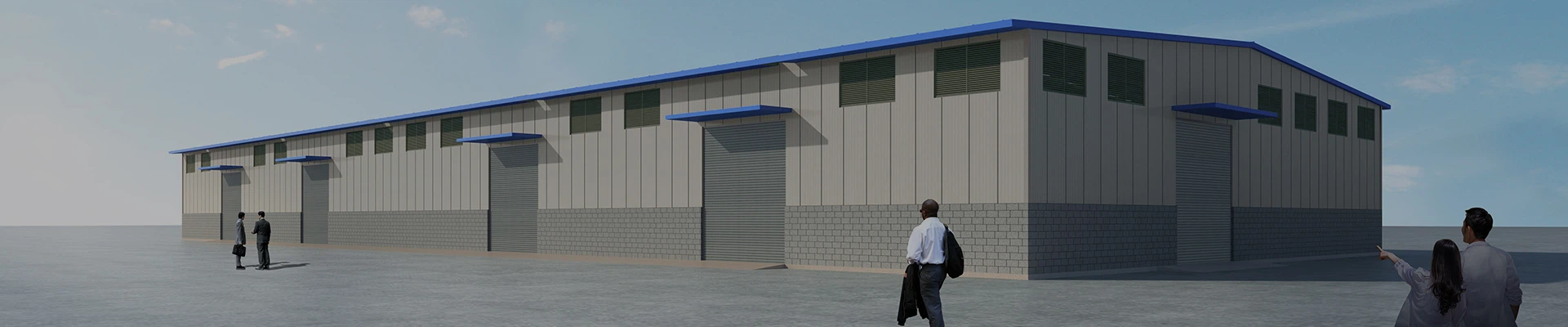
Industrial buildings: Wall and roof cladding for various industrial workshops, warehouses, logistics centers, and aircraft hangars.
Public and commercial buildings: Enclosure structures for gymnasiums, exhibition halls, supermarkets, shopping malls, and cold storage facilities.
Clean and constant temperature environments: Clean workshops and constant temperature & humidity workshops for electronics, pharmaceutical, food and other industries.
Combined housing: Walls, roofs and partitions for prefabricated houses and temporary buildings.
Existing building energy-saving renovations: Covering layers for external or internal wall insulation.
Analysis of Advantages and Disadvantages
Advantages
1.High fire safety: This is its core advantage over polystyrene (EPS) and polyurethane (PU) sandwich panels. It is especially suitable for places with strict fire safety regulations.
2.Environmental protection and health: Glass wool has a stable composition. It contains no harmful foaming agents such as CFC/HCFC, and its waste can be recycled.
3.Balanced comprehensive performance: It integrates thermal insulation, fire protection, sound insulation and structural functions. It offers great value for money.
4.Good water repellency: High-quality glass wool is treated with water-repellent technology. It is not easy to get damp, and its long-term thermal insulation performance remains stable.
5.Good dimensional stability: It is not easily affected by temperature changes, thus avoiding expansion, contraction or deformation.
Disadvantages
1.Relatively heavy self-weight: Compared with PU/PIR sandwich panels, under the same thermal insulation effect, the glass wool core has a higher density, making the overall panel heavier. It requires slightly higher load-bearing capacity of the main structure.
2.Relatively low compression/bending strength: The core material itself has lower strength than rigid foam plastics (PU/PIR). Special attention is required when it needs to bear large concentrated loads or be used as a load-bearing panel. Usually, it is necessary to increase the density of keels or select high-density core materials.
3.Careful edge treatment required: If the panel edges are not properly sealed, the core material may absorb moisture in long-term humid environments, leading to reduced thermal insulation performance. Waterproof sealing of joints must be done properly during installation.
4.Protection required during installation: During cutting or installation, glass fiber debris may irritate the skin and respiratory tract. Construction workers must wear protective equipment such as gloves, masks, and goggles.
5.Cost: Usually more expensive than EPS sandwich panels, but offers a cost advantage over high-end PU/PIR fire-resistant panels.

Suggestions for Selection and Use
1.Clear Requirements:
Fire protection specifications and thermal insulation requirements are the top priorities. If fire protection is the primary concern, glass wool or rock wool panels are the first choice; if extreme thermal insulation is pursued with limited load-bearing capacity, PU/PIR panels are more optimal.
2.Focus on Core Material Density:
Density directly affects strength and thermal insulation performance. The density requirement for core materials used in roofs is usually higher than that for walls.
3. Quality Inspection:
Check if the core material is uniform and free from shedding, if the panel coating is intact, and if the bonding is firm (a peel test can be performed).
4. Emphasize Installation and Sealing:
Construction must be carried out in strict accordance with specifications to ensure firm connections between panels and between panels and keels. Special sealants, plugs, and other materials should be used for waterproof sealing of all joints-this is the key to ensuring long-term performance.
To summarize, glass wool sandwich panels are an "all-round" enclosure material that achieves an excellent balance between fire safety, thermal insulation, and sound absorption. They are particularly suitable for medium and large industrial and public buildings that have clear fire protection requirements while also demanding good thermal insulation and sound insulation performance.
Hot Tags: glass fibre sandwich panel, China glass fibre sandwich panel manufacturers, suppliers, factory, Glass Wool Sandwich Wall Panels, exterior panel wall